
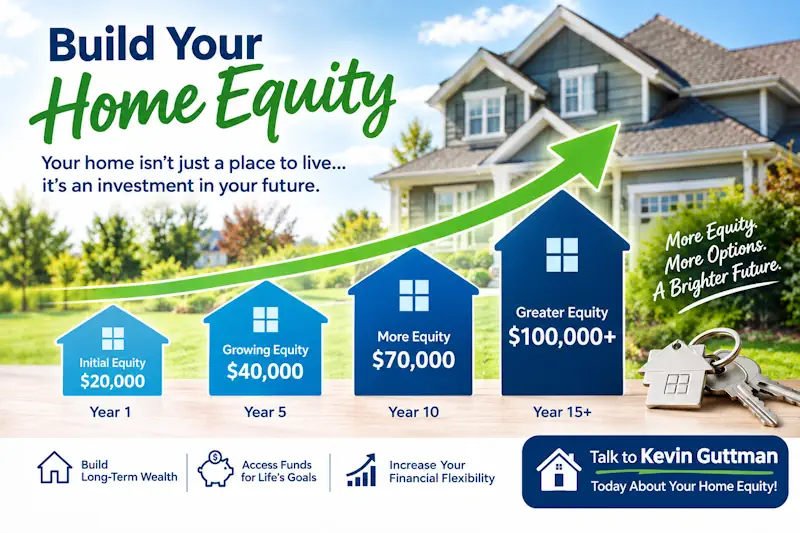
Most Homeowners Have One Potential Source of Equity Growth in Their Home. A Reverse Mortgage Homeowner Can Potentially Have Three.
For most homeowners, there is one primary way their home can financially benefit them over time: property equity appreciation.
If you purchased a home for $400,000 and years later it is worth $600,000, you’ve benefited from a $200,000 increase in the property’s value.
But homeowners with a Home Equity Conversion Mortgage (HECM), commonly called a
reverse mortgage, can potentially benefit from three different types of growth:
1. Property value growth
2. Principal limit growth
3. Line-of-credit growth
Understanding how these three work together is one of the most overlooked—and
potentially powerful—aspects of a reverse mortgage.
1. Property Value Growth
Let’s start with the one most homeowners already understand.
You still own your home when you have a reverse mortgage. A reverse mortgage does not
transfer ownership of your property to the lender.
That means when your home appreciates, you benefit from that appreciation.
Suppose your home is worth $700,000 today and grows in value to $900,000 over time. That additional $200,000 in property value belongs to you—not the reverse mortgage company.
When the home is eventually sold, the reverse mortgage balance is repaid, and the
remaining equity belongs to you or, after your death, your estate.
Of course, home values can rise or fall, and appreciation is never guaranteed. But having a
reverse mortgage does not prevent you from benefiting when your home increases in value.
2. Principal Limit Growth
Here’s where a reverse mortgage becomes particularly interesting.
With an adjustable-rate HECM, your principal limit can grow over time.
Think of the principal limit as the framework that determines the amount of borrowing
capacity available under your HECM.
This growth is separate from what happens to the market value of your home. Your home’s
value may rise, remain relatively flat, or decline during a particular period, while the
HECM’s principal-limit growth mechanism operates according to the terms of the loan.
That can create additional borrowing capacity as you move through retirement.
3. Line-of-Credit Growth
For many homeowners, this is one of the most powerful—and least understood—features
of a HECM.
If you establish a HECM line of credit and leave some of it unused, your available line of
credit can grow over time.
This does not mean your money is sitting in an account earning interest. A HECM line of
credit is not an investment or savings account.
Instead, your available borrowing capacity increases.
For example, imagine having $150,000 available in your reverse mortgage line of credit
today and choosing not to use it. Subject to the terms of the HECM, that unused borrowing
capacity can increase over time.
This can be especially valuable because line-of-credit growth is not dependent upon your
home’s future appreciation.
You potentially have an additional financial resource growing in availability while still
retaining ownership of your home and benefiting from any property appreciation that
occurs.
One Home. Three Potential Sources of Growth.
This is the part I wish more homeowners approaching retirement understood.
Most homeowners potentially benefit from:
Property appreciation
But a homeowner with the right reverse mortgage strategy can potentially benefit from:
Property appreciation + Principal limit growth + Line-of-credit growth
Those are three distinct concepts working within the same retirement strategy.
Why This Matters in Retirement
Retirement could last 20, 30, or even 40 years.
During that time, you may encounter inflation, increasing insurance and property taxes,
healthcare expenses, home repairs, market downturns, long-term care needs, or simply
opportunities to enjoy retirement that require additional cash flow.
A HECM can provide another source of financial flexibility.
Depending on your situation, a reverse mortgage line of credit could potentially help
supplement retirement income, provide funds for unexpected expenses, pay for home
improvements, create an emergency reserve, or reduce the need to sell investments during
a market downturn.
Meanwhile, you remain the homeowner and continue to participate in any future appreciation of your property.
Put the Equity You’ve Built to Work
For many Americans, their home is one of their largest financial assets.
You’ve spent decades making mortgage payments, maintaining your property, and building
equity. That equity represents real wealth.
A reverse mortgage isn’t appropriate for everyone. But for the right homeowner, it can
provide a very different way of thinking about home equity.
Instead of simply owning an appreciating asset, you may be able to combine property
value growth, principal limit growth, and line-of-credit growth as part of a broader retirement strategy.
So instead of only asking:
“How much equity do I have in my home?”
Consider asking a different question:
“How can I put the equity I’ve spent decades building to work for me throughout retirement?”