
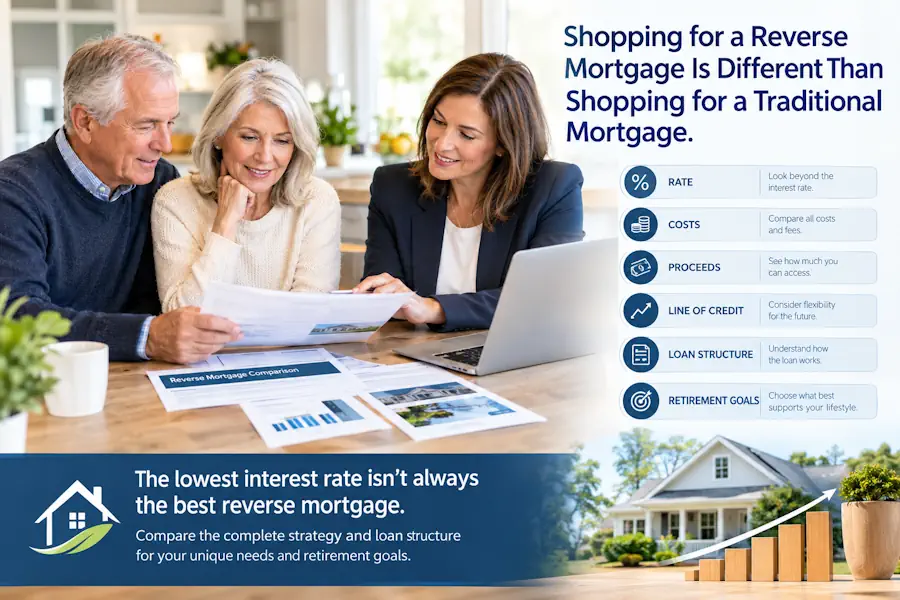
Shopping for a Reverse Mortgage Is Different Than Shopping for a Traditional Mortgage
When shopping for a traditional mortgage, most borrowers naturally focus on a few familiar questions:
What is the interest rate? What are the closing costs? What will my monthly payment be?
Those are important questions. But when shopping for a reverse mortgage, particularly a Home Equity Conversion Mortgage (HECM), simply comparing interest rates and closing costs may not tell you which loan is the best fit.
A reverse mortgage is different because it isn’t simply a loan—it’s a retirement planning and cash-flow tool that can be structured in several different ways.
With a Traditional Mortgage, the Monthly Payment Is Usually the Main Focus
With a traditional mortgage, you borrow a specific amount of money and agree to repay it over a specified period—often 15 or 30 years.
The interest rate directly affects your required monthly principal and interest payment, so comparing rates and closing costs makes sense.
A reverse mortgage works differently.
With a reverse mortgage, mandatory monthly principal and interest mortgage payments are optional as long as you meet the loan requirements, including living in the home as your primary residence and keeping property taxes, homeowners insurance and applicable property charges current.
That changes the conversation considerably.
Don’t Shop for a Reverse Mortgage Based on Interest Rate Alone
Interest rate still matters. It affects how quickly your loan balance may grow and, depending on the type of reverse mortgage, can affect the amount of proceeds available to you.
But it is only one piece of the puzzle.
When comparing reverse mortgages, I encourage homeowners to consider several questions:
- How much money will I actually have available?
- What are my total closing costs?
- Should I choose a fixed or adjustable-rate reverse mortgage?
- Do I need money now, or would a line of credit be more valuable?
- How does the line of credit work?
- What happens to unused borrowing capacity over time?
- Would making my existing mandatory monthly mortgage payment optional improve my retirement cash flow?
- How long do I expect to remain in the home?
- How does this fit with my investments and other retirement assets?
- What do I ultimately want to accomplish with my home equity?
The right answer can be different for every homeowner.
Pay Particular Attention to the HECM Line of Credit
This is one of the biggest differences between shopping for a traditional mortgage and a reverse mortgage.
With an adjustable-rate HECM, eligible borrowers may choose to leave available proceeds in a line of credit rather than taking all the money immediately.
Unused borrowing capacity can grow over time based on the terms of the HECM. The growth rate is tied to the loan’s interest rate plus the annual mortgage insurance premium rate.
That can make the line of credit increasingly valuable over a long retirement.
Importantly, line-of-credit growth isn’t interest being earned on your money. Instead, the amount you’re eligible to borrow increases.
That’s an important distinction.
The Lowest Rate Isn’t Automatically the Best Reverse Mortgage
Suppose Lender A offers a slightly lower interest rate but substantially higher closing costs.
Lender B offers a slightly higher rate but provides lender credits that dramatically reduce your upfront costs.
Which is better?
It depends.
If you plan to keep the reverse mortgage for many years and expect to carry a substantial loan balance, the lower rate could become increasingly valuable.
If your initial balance will be relatively small, or you’re uncertain how long you’ll keep the loan, minimizing upfront costs might be more important.
That’s why simply asking:
“What’s your reverse mortgage rate?”
doesn’t give you enough information to make a good comparison.
A better question is:
“What combination of rate, proceeds, costs and loan structure best accomplishes what I want?”
Compare the Same Loan Structure
This is extremely important when getting quotes from different reverse mortgage lenders.
Make sure you’re comparing apples to apples.
If one lender is quoting an adjustable-rate HECM with a line of credit and another is quoting a fixed-rate HECM with a lump-sum distribution, you aren’t comparing the same thing.
When comparing quotes, look at the same:
- Loan type
- Initial proceeds
- Interest-rate structure
- Expected rate, where applicable
- Margin, where applicable
- Closing costs and lender credits
- Available line of credit
- Initial loan balance
Then you can make a meaningful comparison.
Don’t Assume Every Reverse Mortgage Is a HECM
Another important difference is that there is more than one type of reverse mortgage.
The FHA-insured HECM is the best-known reverse mortgage, but proprietary or “jumbo” reverse mortgages are also available.
Proprietary reverse mortgages can be particularly important for homeowners with higher-value homes. Depending on the program, they may offer substantially higher lending limits or different features than a HECM.
Some proprietary programs are also available beginning at age 55 in eligible states, while HECMs generally begin at age 62.
So before choosing a lender, ask whether that lender has access to multiple reverse mortgage programs or only a limited selection.
Who You Work With Matters: Consider a Mortgage Broker, a Reverse Mortgage Specialist and a CRMP
When shopping for a reverse mortgage, who you work with can be just as important as the loan itself.
First, consider working with an experienced mortgage broker. A broker may have access to multiple lenders and reverse mortgage products rather than being limited to the programs offered by a single lender. That can provide more choices when comparing interest rates, lender credits, closing costs, HECMs and proprietary or jumbo reverse mortgages.
Second, work with someone who specializes in reverse mortgages. These aren’t ordinary home loans. Reverse mortgages have unique rules, terminology, payout options and long-term considerations. You want someone who works with these loans regularly and can explain not only how to get a reverse mortgage, but how to structure one around your retirement goals.
Finally, look for the Certified Reverse Mortgage Professional (CRMP) designation. A CRMP has demonstrated an additional commitment to the reverse mortgage profession through experience, education, ethics and ongoing continuing-education requirements.
When interviewing a reverse mortgage professional, don’t be afraid to ask:
- Are you a mortgage broker with access to multiple reverse mortgage lenders?
- How much of your business is focused on reverse mortgages?
- How many years have you been working with reverse mortgages?
- Are you a Certified Reverse Mortgage Professional (CRMP)?
- Will you help me compare both HECM and proprietary reverse mortgage options?
- Will you still be available to help me after my loan closes?
A reverse mortgage can affect your home equity, retirement cash flow and estate for many years. Choose someone who has the experience, specialization and access to help you evaluate your options—not simply someone who can sell you a reverse mortgage.
Experience Matters More With a Reverse Mortgage
Reverse mortgages are specialized loans.
The person helping you should be able to explain—in plain English—not just the interest rate, but also:
- Principal Limit
- Maximum Claim Amount
- Line-of-credit growth
- Initial versus future borrowing availability
- Fixed versus adjustable HECMs
- FHA mortgage insurance
- Non-recourse protection
- Expected rate and margin
- How payments affect the loan balance and available line of credit
- What happens when the loan eventually becomes due
If those concepts aren’t being clearly explained to you, keep asking questions.
You should understand what you’re signing and why you’ve chosen a particular structure.
Consider How the Reverse Mortgage Fits Into Your Retirement Plan
This may be the biggest difference of all.
A traditional mortgage is primarily about financing a home.
A reverse mortgage can also be about managing retirement.
Home equity may potentially be used to:
- Make an existing mandatory monthly mortgage payment optional
- Supplement retirement cash flow
- Establish an emergency reserve
- Fund home improvements
- Help pay for long-term care or other expenses
- Provide another source of funds during a market downturn rather than selling investments
- Purchase another home using a HECM for Purchase
- Create greater liquidity and financial flexibility
- Help family members or charities while you’re still alive
The question isn’t simply:
“How much can I borrow?”
A much better question is:
“How can I use my home equity most effectively during retirement?”
Ask About Service After Closing, Too
Your relationship with your reverse mortgage professional shouldn’t necessarily end at closing.
You may have questions years later about your loan balance, line of credit, annual occupancy certification, servicing, making voluntary payments, drawing additional funds, or what happens when the home is eventually sold.
Ask your loan officer:
“Will you still be available to help me after my loan closes?”
That answer matters.
The Bottom Line
Shopping for a reverse mortgage shouldn’t be a race to find the lowest advertised interest rate.
Compare the entire strategy—and the professional helping you create it.
Look at the rate. Look at the costs. Look at the proceeds. Understand the line of credit. Compare the programs available to you. Consider how long you expect to stay in your home. Work with someone who specializes in reverse mortgages, and consider the advantages of working with an experienced mortgage broker and a CRMP.
Most importantly, determine how the reverse mortgage fits into your overall retirement goals.
A reverse mortgage can be a powerful financial tool, but like any financial tool, how you use it matters.
My goal is to educate you about your choices, show you the numbers clearly, compare multiple options when appropriate, and help you determine whether a reverse mortgage—and which type of reverse mortgage—makes sense for you.
Senior Mortgage Broker & Reverse Mortgage Specialist
C2 Financial
NMLS #384936
877-251-9709